
Picture two scenarios. In the first, a retailer finds the perfect site, except a direct competitor is already operating two doors down. In the second, a retailer finds an empty stretch of road with zero competitors nearby. Which one is the safer bet?
Most people’s instinct says the second. But that instinct is wrong more often than you would think.
Contents
Why Proximity to Competitors Isn’t Automatically Bad
Retail has a well-documented tendency to cluster. Car dealerships sit next to other car dealerships. Furniture stores group together. Coffee shops open across the street from other coffee shops. This is not an accident, and it is not always bad news for the businesses involved.
Economists call this agglomeration: the tendency for similar businesses to benefit from being near each other because they collectively pull in more total customers than any single store could attract alone. A cluster of furniture stores becomes a destination. A single furniture store on its own has to work much harder to convince someone to make the trip.
A 2024 study analyzing the location patterns of a major Chinese retail chain found that store clustering was shaped by a consistent combination of factors, transportation accessibility, nearby commercial activity, and population density chief among them, rather than competitor avoidance alone (Zhang, Zhou, Chen, & Wang, 2024). In other words, smart retailers are not simply avoiding each other. They are reading the same signals about where demand concentrates.
When Proximity Helps and When It Hurts
The catch is that clustering works differently depending on what you sell.
- Destination categories benefit from proximity: furniture, electronics, home improvement, and other considered purchases tend to gain from being near competitors, because shoppers comparison shop and a cluster increases the odds they visit your store too.
- Convenience categories often suffer from proximity: minimarkets, pharmacies, and quick-service food are usually chosen based on whichever option is closest at the moment of need. A second option two doors down genuinely splits the same demand rather than growing it.
- Anchor-dependent categories sit in between: a coffee shop near an office tower can benefit from a competitor if it means the area becomes known as a place to grab coffee, but the benefit shrinks quickly once the number of competing options outpaces the size of the crowd.
Knowing which category your business falls into changes how you should interpret a competitor sitting nearby.
Measuring Competitive Density the Right Way
Counting how many competitors are within a fixed radius is a start, but it is a blunt instrument. A more useful measure accounts for:
- Distance-weighted influence: a competitor 100 meters away matters more than one 800 meters away, and the relationship is rarely a straight line. Influence tends to drop off sharply with distance.
- Relative size and brand strength: a small independent shop and a national chain occupying the same distance from your site do not represent the same level of competitive pressure.
- Category overlap: a competitor selling a similar but not identical product mix competes with you less directly than one selling almost the same assortment.
How Location Intelligence Makes This Measurable
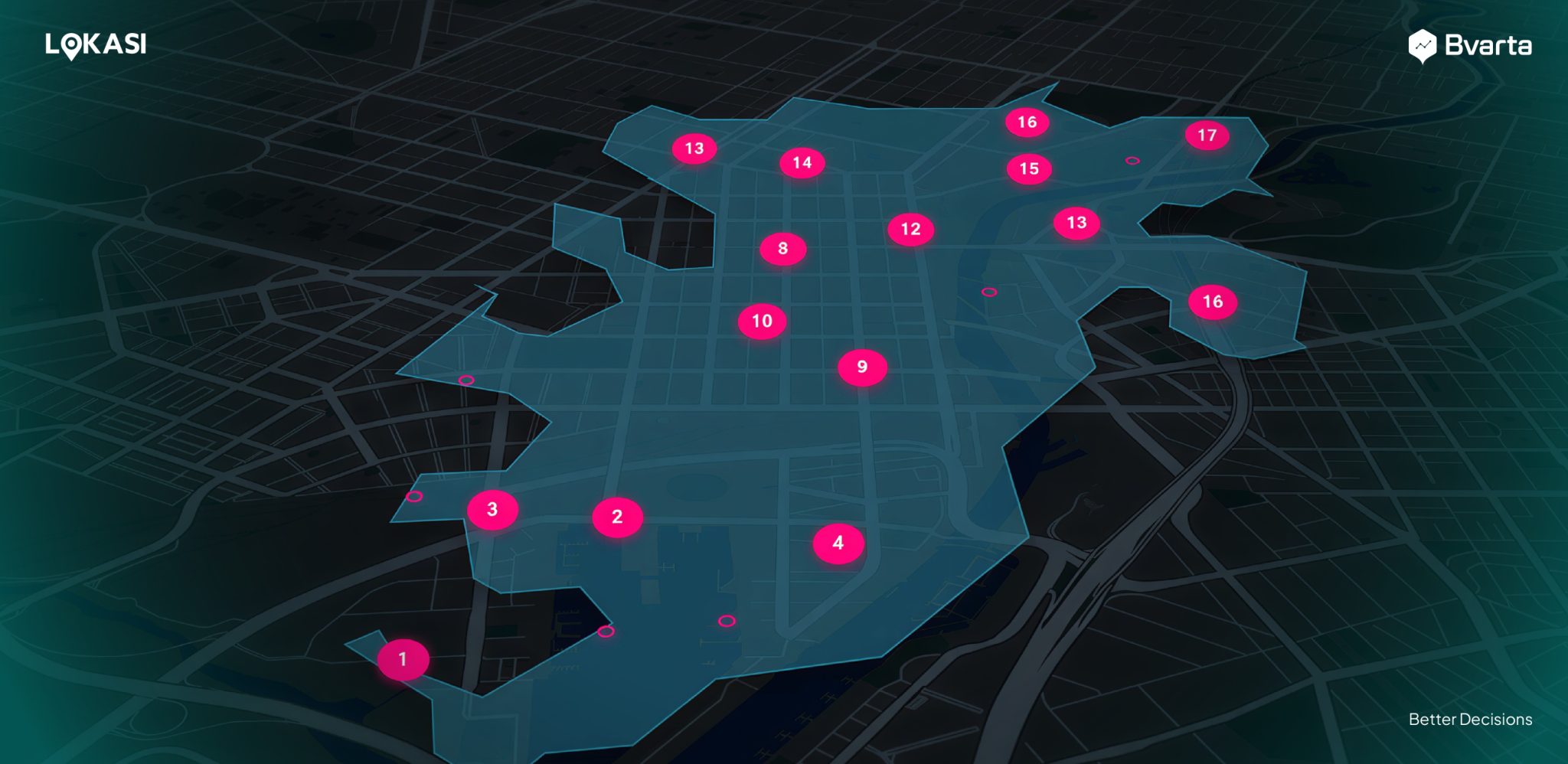
This is exactly the kind of multi-factor calculation that is hard to do by eyeballing a map, but straightforward with the right data layers. Using tools like LOKASI Intelligence, retailers can plot every competitor location within a target trade area, weight each one by distance and estimated scale, and combine that with demographic and mobility data to see the full competitive picture rather than just a headcount.
Figure 1: Heatmap showing competitor proximity and location score across a retail trade area, generated with LOKASI Intelligence.
This turns the instinct of there’s a competitor nearby into a measurable score that can be compared across multiple candidate sites.
A Practical Framework for Competitive Proximity Scoring
When evaluating a potential location, it helps to walk through a simple sequence:
- Identify your category type: are you a destination, convenience, or anchor-dependent business? This determines whether proximity should worry you or reassure you.
- Map all competitors within the realistic trade area, not just the ones visible from the street.
- Weight each competitor by distance and estimated scale, rather than treating every pin on the map as equally threatening.
- Compare the resulting score against other candidate locations, so the decision is relative, not made in isolation.
Trying to decide between two sites and unsure how much competitor proximity should factor in? Bvarta’s team can run a competitive density comparison using your actual target locations.
Get a Free Competitor Proximity Read on Your Own Site
This is exactly the kind of analysis Bvarta runs as part of the LOKASI Health Check-Up, an invited program for site acquisition managers and expansion leaders. Qualified businesses receive one fully value-waived location validation report, including a Competitor Proximity Index, traffic insights, expenditure profiles, and POI density, before a single rupiah goes into a lease. Request your invitation at bvarta.com/lokasi-health-check-up or reach our team directly on WhatsApp at +62 877 7907 7750.
FAQ
Is it ever a good idea to open right next to a direct competitor?
It depends heavily on your category. For destination or comparison-shopping categories, like furniture or electronics, proximity can work in your favor by turning the area into a recognized shopping destination. For convenience categories, where the closest option usually wins, direct proximity is riskier and tends to split demand rather than grow it.
How far away does a competitor need to be before it stops affecting my store?
There is no universal cutoff, since it depends on category, transportation patterns, and how willing customers are to travel for what you sell. Location intelligence platforms typically model this as a distance decay curve rather than a fixed radius, since influence drops off gradually rather than at a hard line.
Should I avoid areas with any competitors at all?
Not necessarily. An area with zero competitors might mean genuine whitespace, or it might mean there is no demand worth competing for. A cluster of competitors, on the other hand, can be a strong signal that the location reliably draws the kind of customer you are also trying to reach.
How is competitor proximity different from a basic competitor count?
A basic count just tallies how many competitors sit within a radius, treating all of them equally. A proximity score accounts for how far away each one actually is, how large or established it is, and how directly its product mix overlaps with yours, giving a much more accurate read of competitive pressure.
References
Zhang, E., Zhou, Y., Chen, G., & Wang, G. (2024). Classified Spatial Clustering and Influencing Factors of New Retail Stores: A Case Study of Freshippo in Shanghai. Sustainability, 16(15), 6643.