
Contents
- 1 Why the Proximity Retail Race Is Moving to the Provinces
- 2 Why Tier-2 and Tier-3 Provinces, and Why Now
- 3 Five Challenges of Winning in Tier-2 and Tier-3 Provinces
- 4 A Step-by-Step Framework for Provincial Store Site Selection
- 5 Location Strategy: Five Factors That Decide Store Performance
- 6 How Location Intelligence Helps You Win the Provinces
- 7 Common Mistakes to Avoid
- 8 Frequently Asked Questions
- 9 References
Why the Proximity Retail Race Is Moving to the Provinces
The data points in one direction.- A record year for small formats. Market research firm Q&Me forecasts convenience stores and mini-supermarkets will grow by 1,865 outlets to 9,671 in 2026, a 23.89% increase [1].
- Provinces now carry the growth. Stores in rural and non-core provincial markets are expected to rise 25.12% to 4,933 outlets, more than half the national total, while Ho Chi Minh City is projected to reach 3,062 stores (up 23.3%) and Hanoi 1,676 (up 21.3%) [1].
- The two domestic giants are setting the pace. WinCommerce opened its 5,000th WinMart+ store in June 2026. In the first five months of the year it added a net 464 stores, of which 374 (81%) were rural WinMart+ outlets, with 339 openings in the north and 119 in central Vietnam [2].
- Bach Hoa Xanh is following. The Mobile World Group chain plans around 1,000 new stores in 2026, mainly in the north, with 20 outlets being piloted in Ninh Binh Province, while WinMart+ also plans 1,000 new stores this year [3].
- Foreign convenience chains are scaling too. GS25 is projected to grow 35% (82 outlets) to 318 stores, FamilyMart about 23% to 172, and 7-Eleven about 14% to 148 [1].
- The headroom is in the provinces. Kantar Worldpanel estimates modern trade accounted for about 35% to 40% of retail sales in urban areas but only 15% to 20% in rural areas in 2025 [3]. Insight Asia puts national modern trade share at around 27% in 2025, rising to 35% by 2030, the fastest growth in ASEAN [4].
- It is not only grocery. Q&Me forecasts that fast-food networks in tier-2 and tier-3 regions will grow from 469 to 629 outlets in 2026, as chains seek untapped middle-class demand while avoiding the high rents of first-tier cities [5].
Why Tier-2 and Tier-3 Provinces, and Why Now
Three forces explain the shift.- Saturation and rent in the metros. Q&Me notes that high rental premiums and market saturation in the largest cities are pushing chains, particularly in fast food, to reallocate capital toward provinces [5].
- Low penetration, less intense competition. Retailers are directing investment to secondary cities and rural provinces where modern retail penetration remains relatively low and competition is lighter [1]. The gap between urban and rural modern trade share is large [3].
- A race for scale with a profitability test. Chains are expanding quickly, but the market is already signaling that weak sites will be closed [1].
Five Challenges of Winning in Tier-2 and Tier-3 Provinces
- Thin visibility: In Hanoi or Ho Chi Minh City, retailers have years of footfall data, competitor intelligence, and local knowledge. In a new province, that visibility is limited, so each site decision carries more risk.
- Spread-out catchments: Provincial stores often serve dispersed communities connected by a few main roads. A simple radius around a site says little about who can actually reach it in five or ten minutes.
- Cannibalization inside your own network: With chains adding stores by the hundreds [2][3], the risk of opening too close to your own outlet is real. Overlapping catchments split the same customers instead of winning new ones.
- Crowded competitor targeting: Domestic giants and foreign chains are all looking at the same provinces [1][2]. Several rivals can converge on the same town center at the same time.
- The cost of a wrong site: With underperforming stores expected to be closed [1], a mistake means more than a slow ramp-up. It means lost lease, fit-out, and inventory investment.
A Step-by-Step Framework for Provincial Store Site Selection
- Step 1: Prioritize provinces. Start at the province level. Compare population, urbanization, income signals, and current store density to pick where to focus first.
- Step 2: Map every store, yours and your competitors’. Plot all existing modern retail outlets in the target area, so you can see where coverage is dense and where it is thin.
- Step 3: Build drive-time catchments. Calculate 5-minute and 10-minute drive-time catchments around each existing store and each candidate site. These show real reach along the road network, not straight-line distance.
- Step 4: Overlay demand. Layer population density, residential growth, schools, markets, industrial parks, transport nodes, and other footfall anchors onto the catchments to see where people actually gather.
- Step 5: Measure overlap. Compare the catchment of each candidate with your existing stores. High overlap signals cannibalization. Low overlap with high demand signals white space.
- Step 6: Rank and validate. Score each candidate on demand, overlap, competition, and feasibility, then validate the top sites on the ground (frontage, parking, rent, delivery access).
- Step 7: Open, measure, and refine. Track store performance against the catchment forecast, and feed the results back into the next wave of openings.
Location Strategy: Five Factors That Decide Store Performance
- Catchment demand. How many people live and work within a 5-minute and 10-minute drive, and how quickly is the area growing?
- Drive-time access. How easily can customers reach the site along the actual road network?
- Footfall anchors. Markets, schools, factories, bus stops, clinics, and residential clusters drive daily visits in smaller towns.
- Competition and overlap. How many rival outlets and how many of your own stores already serve the same catchment?
- Site feasibility. Frontage, parking, rent, and delivery distance from your distribution hub decide whether a good location is a workable one.
How Location Intelligence Helps You Win the Provinces
Location intelligence combines geospatial data, population and mobility signals, points of interest, and competitor coverage in one analytical view, so candidate sites can be compared on the same terms.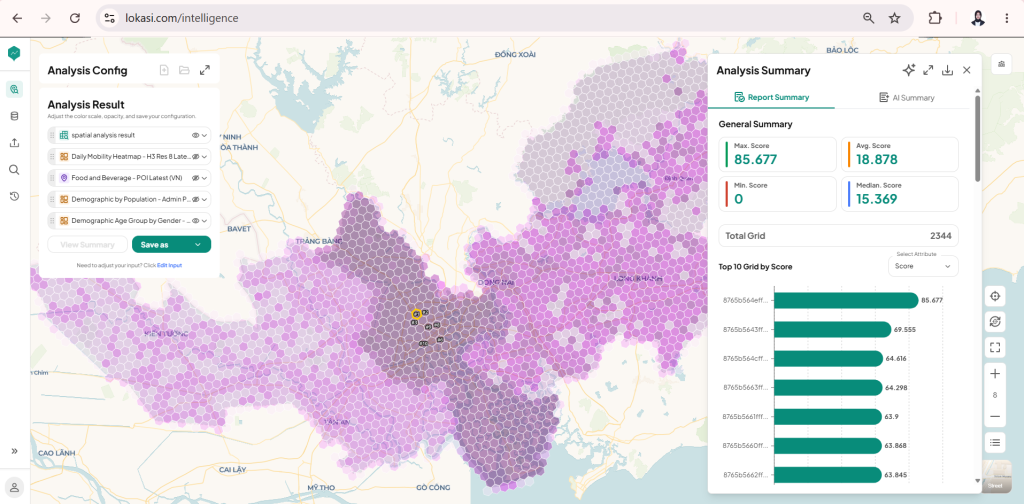
Area Analysis in Vietnam Area using LOKASI Intelligence Platform
With a platform such as LOKASI Intelligence by Bvarta, retail planners can:- Analyze drive-time catchments. Model 5-minute and 10-minute isochrones around any candidate site or existing store, so reach is measured by travel time along the road network, not by a circle on a map.
- Detect cannibalization before you build. Overlay candidate catchments on your current network to see exactly how much of the new store’s reach is already served by your own outlets.
- Find the white space. Highlight high-demand areas that sit outside every existing catchment, yours and your competitors’, in a province or across several.
- Profile each catchment. Understand the residences, markets, schools, workplaces, and transport nodes inside the catchment to estimate daily footfall potential.
- Map the competition. See where rival chains are already present and where they are likely to move next.
- Rank and shortlist sites at scale. Compare dozens of candidate sites across multiple provinces, so the rollout order follows the evidence.
Common Mistakes to Avoid
- Chasing store count over store quality. Scale without profitability leads to closures [1].
- Measuring distance instead of time. Straight-line radius misrepresents real customer reach.
- Ignoring your own network. A new store that takes sales from an existing one adds cost, not revenue.
- Copying competitors’ sites. Following a rival into a town can mean sharing demand rather than finding it.
- Using big-city assumptions in small towns. Footfall anchors, shopping hours, and catchment shapes differ in provinces.
- Waiting too long. In a land-grab, the best corner goes to the first retailer that identifies it.
Frequently Asked Questions
- What is proximity retail? Proximity retail refers to small-format stores such as convenience stores and mini-supermarkets that sell daily necessities close to where people live, with a focus on frequent, quick purchases.
- Why are retailers expanding into tier-2 and tier-3 provinces? Because the largest cities are saturated and expensive, while provincial markets have lower modern trade penetration and less intense competition [1][5]. In 2025, modern trade held about 35% to 40% of retail sales in urban areas and 15% to 20% in rural areas [3].
- How fast are Vietnam’s convenience stores growing? Q&Me forecasts a 23.89% rise to 9,671 outlets in 2026, with stores in rural and non-core provincial markets growing 25.12% to 4,933 [1].
- What is a drive-time catchment? A drive-time catchment (isochrone) is the area a customer can reach from a store within a set travel time, such as 5 or 10 minutes, calculated along the road network.
- Can location intelligence prevent cannibalization? It cannot eliminate it, but by overlaying candidate catchments on your existing network it shows how much overlap a new site would create, so you can avoid sites that mostly split sales.
- Can location intelligence guarantee a profitable store? No tool can guarantee sales. It replaces assumptions with measurable signals, which lowers the risk of a poor site and helps you decide where to open first.
- Ready to Claim the Best Corners Before Anyone Else Does? The proximity retail race is being decided store by store, province by province. The best sites are limited, and the retailer that identifies them first takes the demand around them.
- LOKASI Intelligence helps you move first. Map existing coverage, analyze drive-time catchments, detect cannibalization, and rank the strongest candidate sites across your target provinces, so you can secure them before a competitor does.
References
Based on market research forecasts, company announcements, and market reporting as of November 2026.- The Investor, Vietnam’s convenience store boom shifts beyond major cities as chains race for scale, 21 May 2026 (citing Q&Me, Vietnam Modern Trade Retail Trends 2026). Link: https://theinvestor.vn/vietnams-convenience-store-boom-shifts-beyond-major-cities-as-chains-race-for-scale-d19128.html
- The Investor, WinMart+ expands to 5,000 stores as Vietnam retailer pushes into rural markets, 26 June 2026. Link: https://theinvestor.vn/winmart-expands-to-5000-stores-as-vietnam-retailer-pushes-into-rural-markets-d19405.html
- Vietnam News, Mini-marts accelerate expansion as modern retail momentum builds, 25 February 2026 (citing Kantar Worldpanel). Link: https://vietnamnews.vn/economy/1766161/mini-marts-accelerate-expansion-as-modern-retail-momentum-builds.html
- Masan Group, Modern Retail Accelerates: Vietnam Leads ASEAN in Market Transition, 27 October 2025 (citing Insight Asia; Masan company publication). Link: https://www.masangroup.com/news/masan-news/Modern-Retail-Accelerates-Vietnam-Leads-ASEAN-in-Market-Transition.html
- The Investor, Vietnam’s fast-food industry expands 13% as chains pivot beyond major cities, KFC leads growth, 24 May 2026 (citing Q&Me). Link: https://theinvestor.vn/vietnams-fast-food-industry-expands-13-as-chains-pivot-beyond-major-cities-kfc-leads-growth-d19145.html