
Every business asks the same fundamental question: who is my customer? Most stop at demographics, age, income, lifestyle. But the most competitive organizations today are asking a deeper question: where does my customer come from, and what does their movement tell me about their intent?
Mobility data and location intelligence have fundamentally changed how businesses understand their market. By analyzing real-world movement patterns, where people live, work, travel, and spend time, companies can now map customer origins with precision, identify untapped demand zones, and make smarter decisions about where to grow, invest, and engage.
This article explores how mobility data and location intelligence work together to help businesses uncover customer origin pattern.
Contents
What Is Mobility Data and Location Intelligence?
Before businesses can act on customer origin insights, they need to understand what powers them. Two interconnected disciplines form the backbone of modern spatial analysis: mobility data and location intelligence.
What Is Mobility Data?
Mobility data refers to the digital trail that people leave as they move through the physical world. Every time a smartphone connects to a cell tower, pings a Wi-Fi network, or logs a GPS coordinate through an app, it generates a data point.
Aggregated across millions of devices and billions of movements, this data creates a detailed picture of how populations behave in space and time. The three primary sources of mobility data are:
- GPS traces are the most precise form of mobility data. Collected through location-enabled apps such as navigation tools, ride-hailing platforms, fitness trackers, GPS traces capture near-exact coordinates of a device’s position at a given moment. When anonymized and aggregated, they reveal origin points, routes taken, and destinations reached with high spatial accuracy.
- Cell signal data is generated whenever a mobile device communicates with a telecom tower. While less precise than GPS, cell signal data offers near-universal coverage and captures population movement even in areas with low smartphone app penetration. Telecom operators process this data at scale, making it particularly valuable for regional and national-level market studies.
- Wi-Fi pings occur when a device scans for or connects to a wireless network. Retailers, shopping malls, airports, and transit hubs have long used Wi-Fi detection to measure foot traffic, dwell time, and repeat visits, making this one of the most commercially accessible forms of mobility data for brick-and-mortar businesses.
Together, these three streams form a comprehensive picture of human movement: where people start, where they go, how long they stay, and how often they return.
What Is Location Intelligence?
If mobility data is the raw signal, location intelligence is the interpretation. Location intelligence is the process of analyzing spatial and geographic data to generate insights that inform business decisions.
It transforms coordinates, timestamps, and movement records into answers to real strategic questions: Where are my customers coming from? Which areas represent untapped demand? Where is my competitive exposure highest?
Location intelligence platforms allow analysts to layer mobility data with demographic profiles, land use maps, competitor locations, infrastructure networks, and consumer spending indices. The result is not just a map, but a decision-support system.
For businesses operating in high-growth markets, where urban expansion, infrastructure development, and shifting consumer mobility patterns evolve rapidly, location intelligence provides a dynamic view of market conditions that static survey data cannot match.
Understanding Customer Origins
Most businesses have a reasonable picture of their customer profile, demographic segments, purchase frequency, and average basket size. What far fewer businesses know is the geographic origin of that customer: where they started their journey before arriving at your door.
Customer origin analysis fills that gap, and in doing so, unlocks a fundamentally more accurate understanding of how demand actually flows toward your business.
What is Customer Origin?
In the context of mobility data and location intelligence, customer origin refers to the geographic starting point of a customer’s journey to a point of interaction with your business. This is not simply a billing address or a postcode field in your CRM. It is the actual spatial behavior of a person, captured through movement data, before they engage with your brand.
Customer origin exists across three primary dimensions:
- Home location is the most stable origin signal. It reflects where a customer lives, their residential neighborhood, district, or city.
- Work location is retail visits that originate not from a customer’s home, but from their place of work.
Understanding these dimensions of customer origin gives businesses a complete and accurate picture of where demand is coming from.
Catchment Area Analysis
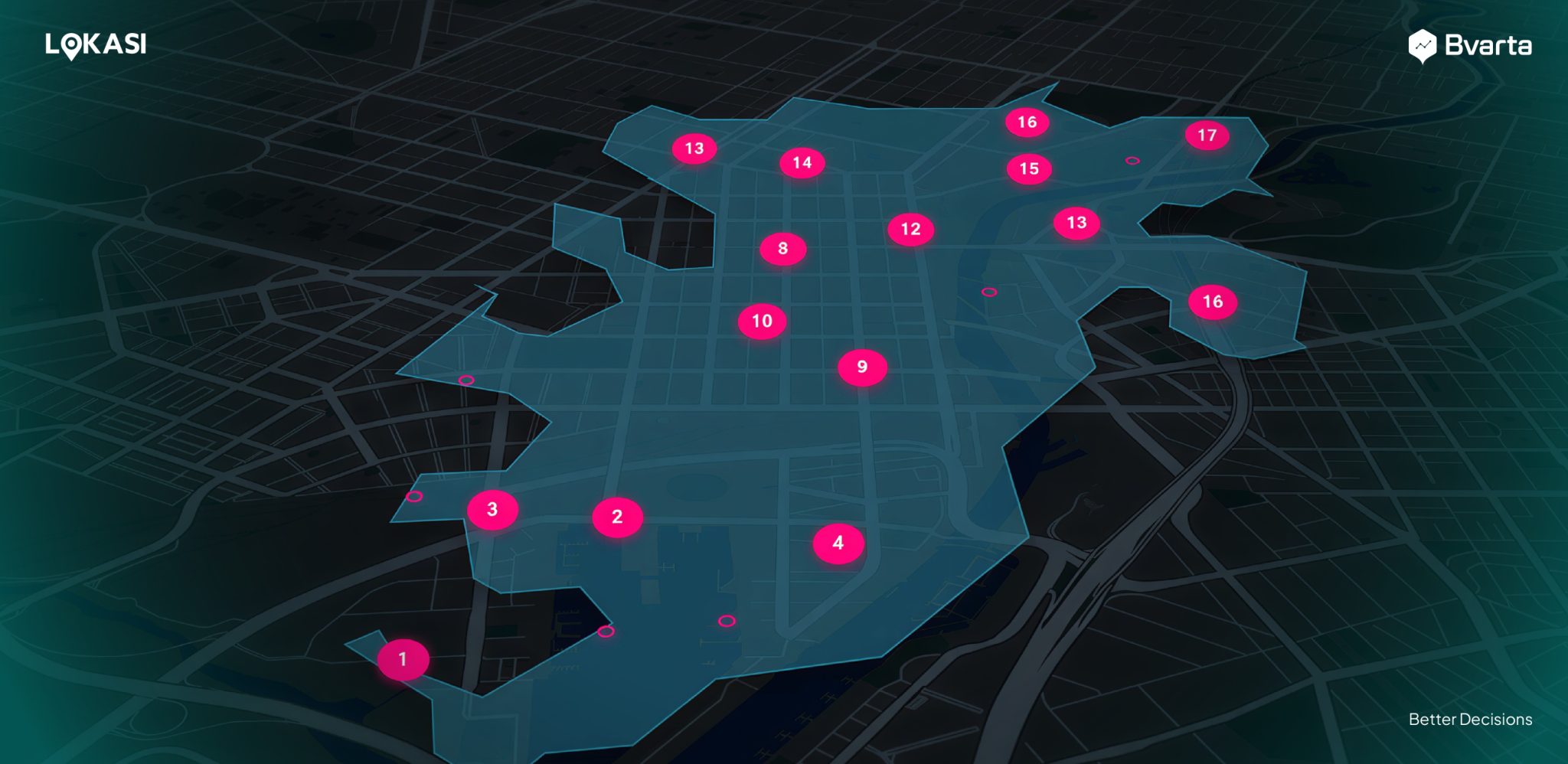
Catchment area analysis is one of the most fundamental applications of customer origin data. A catchment area is the geographic zone from which a business draws the majority of its customers. Unlike a simple drive-time or walk-time radius, a data-driven catchment area is shaped by actual customer movement, and is often far more irregular and asymmetric than a circle on a map would suggest.
Origin-Destination Mapping Analysis
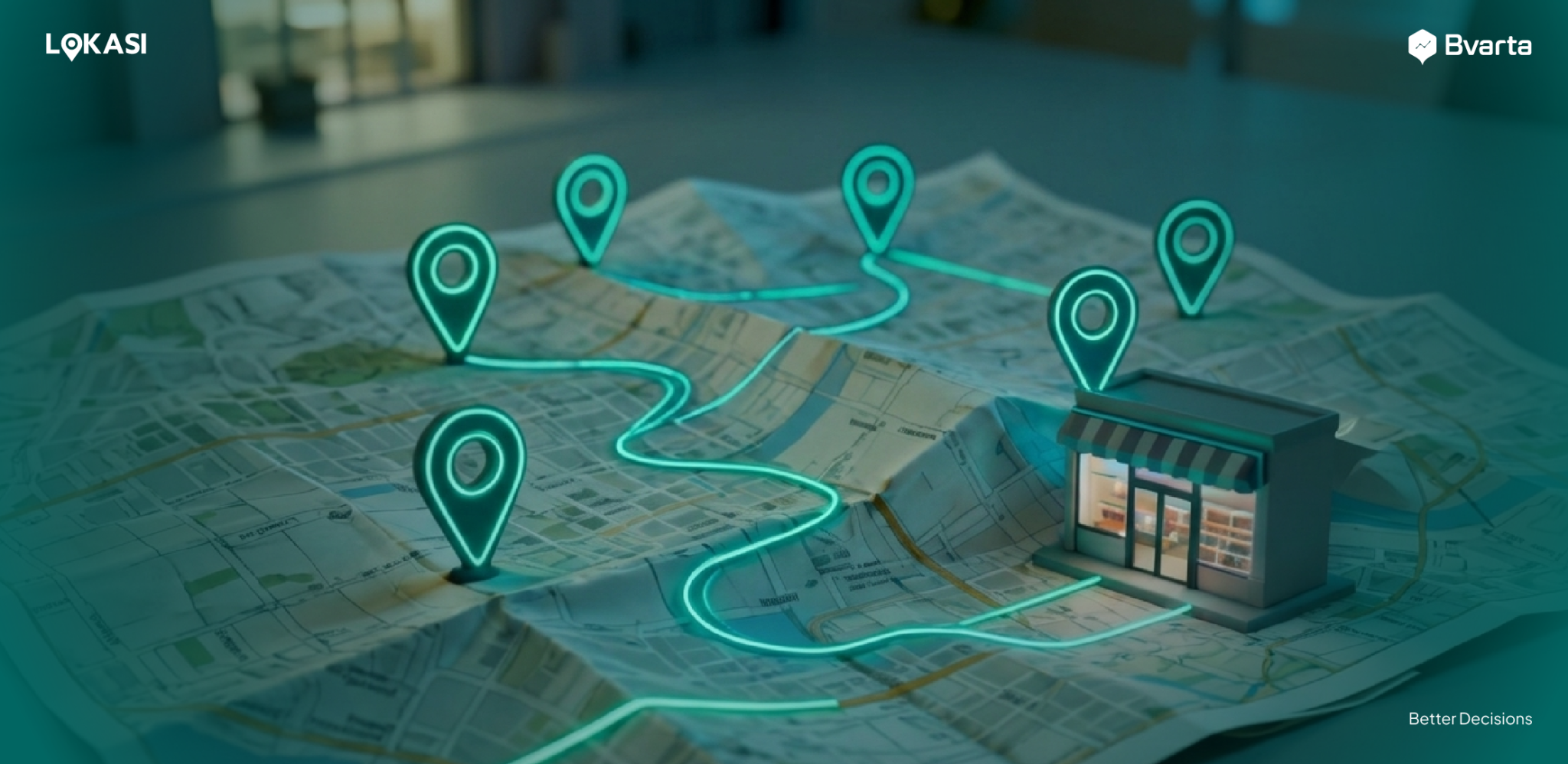
Origin-destination mapping is the analytical methodology that underlies most customer origin intelligence work. At its core, OD mapping connects the starting point of a journey (the origin) to its endpoint (the destination).
In a business context, the destination is typically a store location, a branch, a service point, or a defined geographic area. The origins are the diverse home locations, workplaces, and transit nodes from which customers are traveling to reach it.
OD mapping is constructed using aggregated mobility data, typically derived from GPS traces or cell signal records, that has been processed to identify statistically significant movement flows between geographic units.
The result is a spatial flow map where customers come from, which corridors they travel through, and where they ultimately converge, giving businesses a precise, data-driven picture of how demand flows toward their locations.
Segmenting Customers by Origin
Not all customers who visit a location are the same, and their origin type is one of the most powerful ways to segment them for strategic purposes. Mobility data enables businesses to classify customers into two behaviorally distinct origin segments, each with different implications for marketing, operations, and investment decisions.
- Local customers originate from residential areas within or adjacent to the primary catchment zone. They visit frequently, often habitually, and their behavior is driven by proximity and convenience. Local customers are the most stable revenue base for most physical businesses and the primary audience for loyalty programs, neighborhood-level marketing, and community engagement.
- Commuter customers originate from outside the immediate area but pass through regularly as part of their daily work routine. They tend to visit during specific time windows such as morning, lunch, or evening commute, and their patronage is highly sensitive to changes in commuter infrastructure, remote work patterns, and workplace location shifts. Businesses in transit corridors and CBD-adjacent locations often have a larger commuter customer base
Understand your customer origins with LOKASI
LOKASI is a geospatial platform that integrates location intelligence with rich location data, including mobility data.
With LOKASI, businesses can see where their customers are coming from, which corridors they travel through, where they ultimately arrive, and how long they stay. From the first step of the journey to the last, every movement becomes a business insight.
Whether you are evaluating a new location, benchmarking against competitors, identifying untapped demand zones, or simply trying to understand who is walking through your door and why, LOKASI turns customer movement into decisions you can act on.
Consult us for a free consultation via email: [email protected] or WhatsApp: 0877 7907 7750
FAQ
What is customer origin?
In the context of mobility data and location intelligence, customer origin refers to the geographic starting point of a customer’s journey to a point of interaction with your business.
What is Location Intelligence?
Location Intelligence is the process of analyzing spatial and geographic data to generate insights that support business decisions.
What is mobility data?
Mobility data is the digital trace left behind by a person as they move through the real world. Whenever a smartphone connects to a cell tower, connects to a Wi-Fi network, or records GPS coordinates through an app, that device generates a single data point.