
Many businesses struggle to clearly define their consumer segments. Sometimes the segmentation ends up being too broad and unfocused, other times it’s too narrow, making it hard to reach a wider audience. As a result, marketing strategies don’t hit the mark and fail to deliver the best outcomes.
One way to fix this is by using location-based clustering. This method helps businesses see consumer patterns more clearly, based on where they are, how they behave, and the unique traits of people in a certain area.
With more accurate segmentation, it becomes much easier to create targeted campaigns, offer products that really fit market needs, and give customers experiences that feel more relevant.
In this article, we’ll dive into how location-based clustering can sharpen consumer segmentation and help businesses grow more effectively.
Contents
Understanding Location Clustering Analysis
Clustering algorithms are data analysis techniques used to group people, objects, or entities into clusters based on shared similarities.
This method is especially useful when working with large datasets, as it simplifies complex information by organizing similar items into easily understood categories. The main objective is to reduce data complexity while uncovering patterns that might otherwise be difficult to detect in raw data.
One variation of clustering is location-based clustering. Unlike traditional clustering, this approach focuses on grouping geographic data, such as location points, addresses, or coordinates, into clusters based on spatial proximity and common characteristics.
With this technique, businesses can gain deeper insights into consumer behavior, identify high-potential areas, and detect anomalies that may reveal new opportunities or potential risks.
By applying location-based clustering, companies can not only create more accurate consumer segmentation but also enhance the quality of their products and services to better meet the needs of specific regions.
Location-Based Clustering Use Cases in Business
The use of location-based clustering is becoming increasingly widespread across various industries. Here are some practical use cases that can help businesses maximize growth.
Financial Institutions
Financial institutions can leverage spatial clustering to identify areas with high or low potential within specific locations.
This analysis enables a more detailed assessment of potential customers’ creditworthiness, down to the address level. As a result, financial institutions can better understand credit risk and enhance the effectiveness of their risk management strategies.
Additionally, location-based clustering helps financial institutions evaluate the coverage of their existing market. For example, by pinpointing areas that are overserved (with too many services or branches) and those that are underserved (with insufficient services), companies can develop targeted strategies to optimize their operations.
Insurance Business
Insurance companies can use location-based clustering to group areas according to similar risk profiles.
This approach can enhance underwriting and pricing processes, for example, by implementing a regional risk ranking system. It is also valuable for detecting potential fraud by identifying suspicious claim patterns that appear geographically.
Moreover, location-based clustering enables insurance companies to manage risk proactively. By mapping insured risks across different locations, companies can develop targeted preventive measures, such as mitigating the impact of natural disasters or crime in specific areas.
The insights gained from this analysis can inform the design of product coverage and policy structures that are more relevant to the needs of each community, resulting in more effective, competitive, and targeted services.
Food and Beverage Business
Location-based clustering is a valuable method for food and beverage companies when determining the best location for opening a new branch.
Through this approach, businesses can identify high-potential areas or clusters based on factors such as foot traffic, demographics, and local consumer behavior.
It also provides insights into the sales potential of each regional cluster. With this information, companies can make more accurate forecasts, predict demand levels in specific areas, and adjust operational strategies accordingly, from raw material inventory and staffing to marketing plans.
Location-based clustering is equally useful for evaluating existing branches. If a branch is underperforming, the analysis can highlight alternative locations with stronger prospects.
By relocating to clusters with higher potential, businesses can maximize growth opportunities while minimizing the risk of operational losses.
Location-Based Clustering Made Easier with LOKASI
LOKASI helps businesses perform location-based clustering analysis by leveraging various types of location data, including points of interest (POIs), demographics, and people traffic.
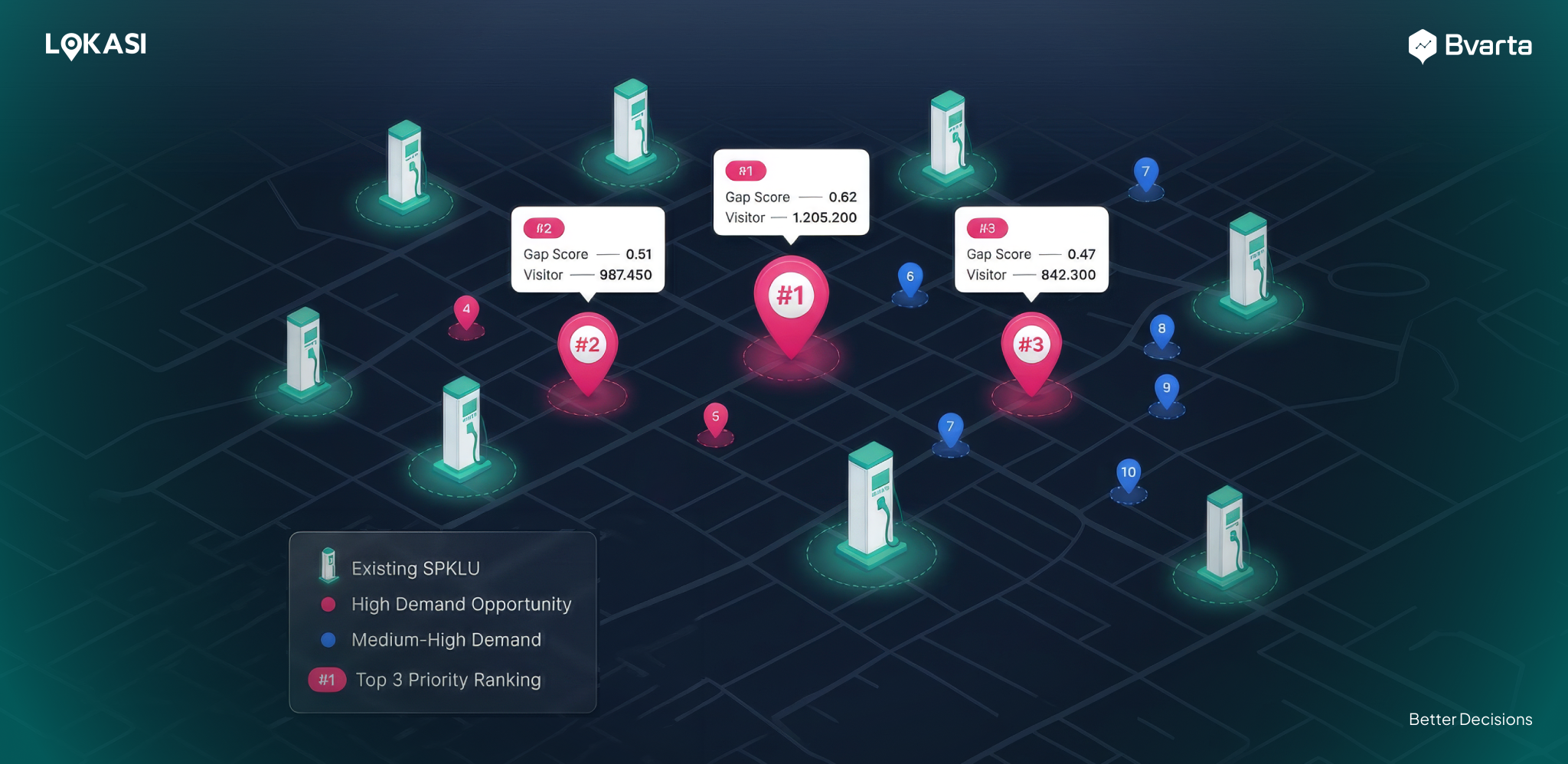
With this analysis, businesses can group areas into clusters—for example, Clusters 1 through 5—each with unique characteristics and sales potential.
This information allows businesses to clearly identify the most promising areas, compare potential across clusters, and select the best locations for new branches to maximize growth opportunities.
Learn more about how LOKASI Intelligence can support your business by contacting us at: [email protected] or WhatsApp: 087779077750
FAQ
What is clustering in databases?
Clustering in databases is a data analysis technique used to group people, objects, or entities into clusters based on their similarities.
Why use clustering methods?
Clustering methods are useful for improving consumer segmentation, identifying sales potential, uncovering patterns, and supporting data-driven decision-making.
What is location-based clustering?
Location-based clustering is a technique that groups geographic data—such as location points, addresses, or coordinates—into clusters based on spatial proximity and shared characteristics.