
Contents
- 1 Why Vietnam’s Charging Puzzle Is Hard to Solve
- 2 What the Multi-Brand Mandate Actually Requires
- 3 Five Pieces of Vietnam’s Charging Puzzle
- 4 A Step-by-Step Framework for Planning a Multi-Brand Charging Network
- 4.1 Step 1: Define your role
- 4.2 Step 2: Design for compatibility from day one
- 4.3 Step 3: Map demand by driver type
- 4.4 Step 4: Choose charger types by dwell time
- 4.5 Step 5: Score locations on a consistent framework
- 4.6 Step 6: Plan interoperability
- 4.7 Step 7: Launch, measure, and expand where the data says
- 5 Location Strategy: Five Factors That Decide Utilization
- 6 How Location Intelligence Solves the Puzzle
- 7
- 8 Common Mistakes to Avoid
- 9 Frequently Asked Questions
- 10 Ready to Solve Your Own Charging Puzzle?
- 11 References
Why Vietnam’s Charging Puzzle Is Hard to Solve
The numbers show demand and supply growing at very different speeds, and in very different shapes.- Car demand is surging. VinFast alone delivered 78,458 electric cars in the first four months of 2026, up 75.56% year on year, and has been Vietnam’s best-selling car brand for 19 consecutive months [3].
- Two-wheelers add a second wave. Electric motorcycle sales rose 97.2% year on year in the first seven months of 2026, nearly doubling in twelve months [4].
- One network dominates. V-Green, the charging arm linked to VinFast, operates around 150,000 charging ports for electric cars and motorbikes across 34 provinces, making it the country’s largest network [5]. In March 2026 it announced a plan to invest about VND 10 trillion (roughly US$380 million) in 99 ultra-fast stations along interprovincial roads [6].
- Independents are scaling fast. TMT EGreen targets 2,100 stations by the end of 2026 and 30,000 by 2030, Singapore’s Charge+ aims for 5,000 charging points by 2030, and EV One had 73 stations by May 2026 [7][8].
- The infrastructure gap is large. The International Energy Agency (IEA) estimates Vietnam needs between 100,000 and 350,000 charging stations over 15 years, roughly one for every ten EVs [9].
What the Multi-Brand Mandate Actually Requires
The rule sits in Circular 61/2026/TT-BCT, issued by the Ministry of Industry and Trade, which promulgates the national technical regulation QCVN 32:2026/BCT [10]. Here is what matters for planners.- Effective date: 1 July 2027 [1][2].
- Scope: charging stations in public areas, parking facilities, rest stops, outdoor locations, and stations under standalone shelters [1].
- Core requirement: stations must be technically designed to serve compatible vehicles from different makers, with compatible connectors, charging modes, and specifications [1][2].
- Price transparency: public stations must also display charging prices [2].
- Penalties: the regulation sets requirements and deadlines but does not itself specify penalties for non-compliance [2].
Five Pieces of Vietnam’s Charging Puzzle
1. Fragmented networks
Without shared standards and apps, charging risks splitting into brand-specific networks, forcing drivers to juggle accounts and stations [11]. Open platforms are emerging, but reliability still varies considerably from station to station [8].2. Cities versus corridors
Urban centers need dense, destination-based charging. Long-distance routes need fast chargers at spaced intervals. V-Green’s 99-station highway plan shows how important corridors have become [6], but corridor coverage is only one part of the map.3. Cars and two-wheelers
Car charging, motorbike charging, and battery swapping serve different behaviors, dwell times, and sites. A location that works for one may not work for another [4].4. Uneven reliability
Even where multi-brand stations exist, service quality varies [8]. A site that is well placed but poorly maintained still loses drivers.5. Grid, land, and cost constraints
The best market location is useless if it cannot get power, parking space, or an affordable lease. Technical, cost, and investment challenges persist across the sector [5].A Step-by-Step Framework for Planning a Multi-Brand Charging Network
Step 1: Define your role
Are you an operator, a property owner hosting chargers, an automaker extending dealer coverage, or an investor? Your role determines how much you control the site, the hardware, and the data.Step 2: Design for compatibility from day one
Build to the technical requirements in QCVN 32:2026/BCT, including connectors, charging modes, and price display, so your stations are ready before 1 July 2027 [2][10]. Retrofitting later costs more than designing correctly now.Step 3: Map demand by driver type
Separate private car owners, ride-hailing and taxi fleets, logistics vehicles, and two-wheeler riders. Each uses charging differently, and each clusters in different districts and routes.Step 4: Choose charger types by dwell time
Fast DC chargers suit short stops on corridors and at busy retail sites. Slower AC charging suits places where people stay for hours, such as offices, hotels, and residential buildings.Step 5: Score locations on a consistent framework
Use the five location factors in the next section so every candidate site is compared on the same terms.Step 6: Plan interoperability
Decide which platforms, apps, and payment partners you will connect to. Open ecosystems are already forming around shared apps and roaming-style access [7][8].Step 7: Launch, measure, and expand where the data says
Track utilization, session length, uptime, and revenue per charger from week one, and use results to choose the next site.Location Strategy: Five Factors That Decide Utilization
- EV demand density. Where do electric vehicles live, work, and travel? Demand differs sharply between districts of the same city.
- Mobility patterns. Who passes by, at what times, and who actually stops? Commuter flows, weekend travel, and fleet routes create different profiles.
- Dwell time and destination quality. Malls, supermarkets, hotels, tourist sites, and business districts give drivers a natural reason to stay 30 to 90 minutes.
- Competition and coverage gaps. Map every existing station, including brand-specific ones that will soon become accessible to other makers. A dense cluster is a warning sign; an empty corridor or district is an opportunity.
- Site feasibility. Check grid capacity, parking layout, visibility, safety, and lease terms before committing.
How Location Intelligence Solves the Puzzle
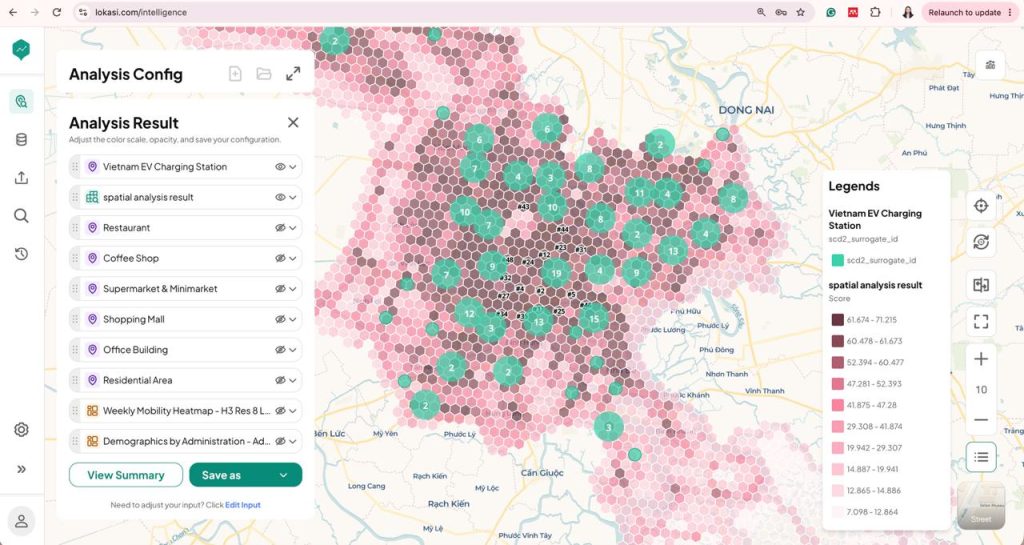
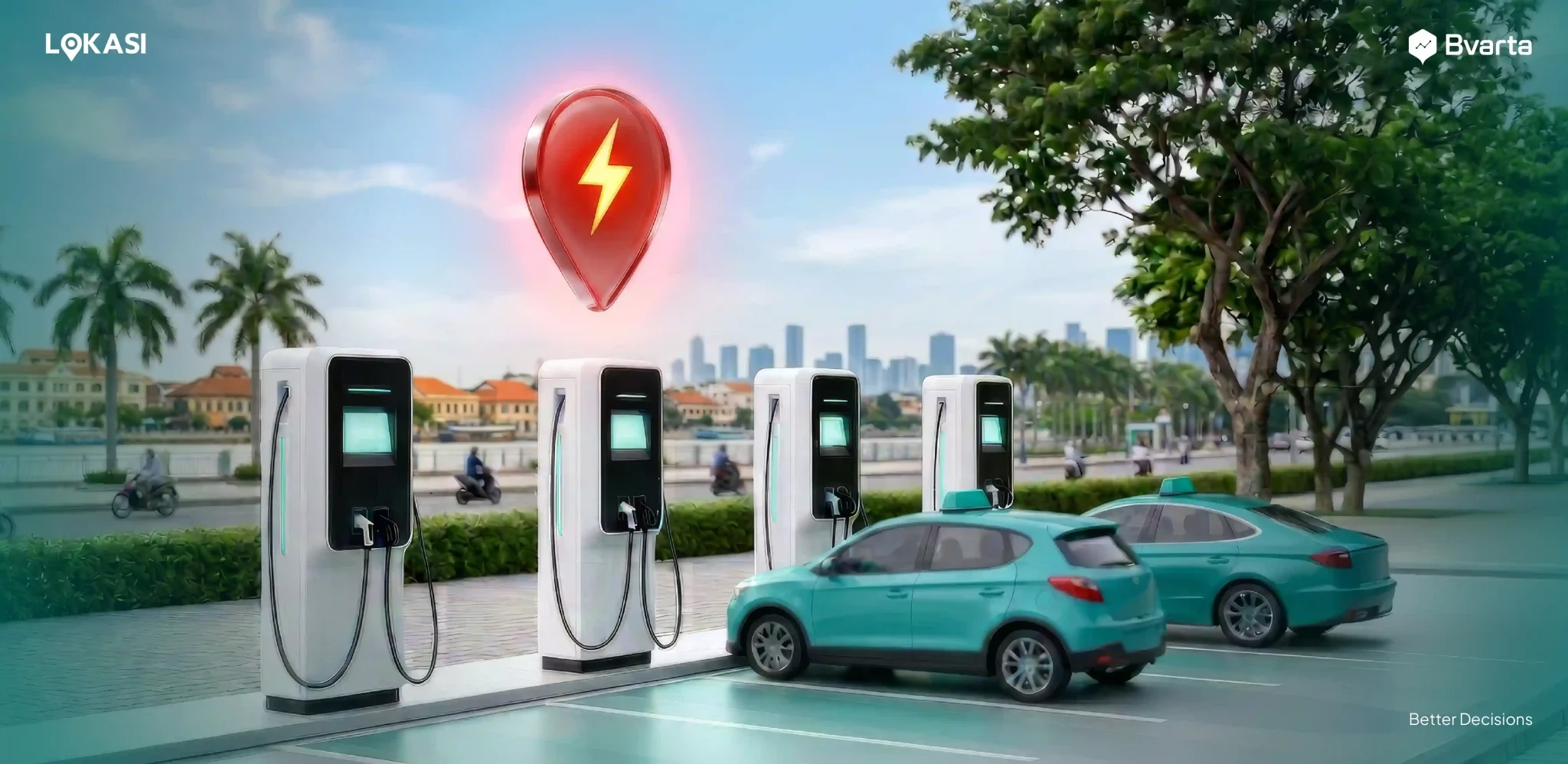
EV Charging Station Potential Analysis in Ho Chi Minh City – Vietnam with LOKASI Intelligence
Location intelligence combines geospatial data, population and mobility signals, points of interest, and competitor mapping into one view, so that candidate sites can be compared objectively.
With a platform such as LOKASI Intelligence by Bvarta, planners can:- See demand before building. Visualize population, activity, and movement patterns around any candidate site, using aggregated mobility insights rather than assumptions.
- Map the competition and the gaps. Identify where charging points already exist, how dense they are, and where coverage is thin within a city or along a route.
- Profile the catchment. Analyze 5-minute and 10-minute drive-time catchments around a highway node or an urban commercial center, then profile the malls, offices, residences, transit hubs, and tourist sites inside each band to estimate dwell time and visit potential.
- Rank and shortlist sites. Compare locations side by side and present the evidence to landowners, partners, and investors.
- Prepare for open networks. When any compatible driver can use any compatible charger, understanding catchment matters more than counting your own brand’s vehicles.
- Scale with confidence. Apply the same analysis across dozens of sites to decide where to roll out first.
Common Mistakes to Avoid
- Assuming a busy road means a busy charger. Traffic only matters if drivers stop.
- Planning for one brand’s drivers. After July 2027, your catchment is every compatible vehicle nearby.
- Copying competitors’ locations without checking whether the area is already saturated.
- Ignoring uptime and reliability. Poor service damages trust faster than a premium location can build it [8].
- Treating compatibility as only a hardware issue. Apps, payments, and roaming agreements decide whether drivers can actually use your station [11].
- Overbuilding early. Start with the capacity your demand data supports, and design the site so it can expand.
Frequently Asked Questions
Does Vietnam require all charging stations to be multi-brand? From 1 July 2027, public charging stations in covered locations must be technically designed to serve compatible vehicles from different makers [1][2]. The rule focuses on technical compatibility, so commercial access between networks still depends on partnerships [11].Which locations does the regulation cover? Public areas, parking facilities, rest stops, outdoor stations, and stations under standalone shelters [1].
What happens if a station does not comply? The regulation sets requirements and deadlines but does not itself specify penalties [2]. Operators should still plan for compliance, because non-compliant stations risk being excluded from open networks and partnerships.
Who are the main charging players in Vietnam? V-Green, linked to VinFast, runs the largest network, with around 150,000 ports [5]. Independents and partnerships such as TMT EGreen, Charge+, EV One, and the VETC platform are expanding quickly [7][8].
Can location intelligence guarantee a profitable site? No tool can guarantee demand. It replaces assumptions with measurable signals, lowering the risk of a poor location and helping you prioritize where to build first.
Ready to Solve Your Own Charging Puzzle?
From July 2027, no charger is protected by one brand’s loyal drivers. Every compatible vehicle can plug in anywhere, so operators, automakers, and property owners will compete for the same prime sites: the highway nodes, commercial centers, and destinations where drivers already stop. Those sites are limited, and the first player to secure one captures the demand around it. LOKASI Intelligence helps you move first. Analyze drive-time catchments, demand, mobility patterns, and competitor coverage across your target cities and corridors, rank the strongest candidate sites, and lock them in before another brand does. Build your location pipeline now, so that when the mandate takes effect, your chargers are already where the drivers are.References
- Based on ministry announcements, company disclosures, and market reporting as of October 2026.
- Vietnam News, Charging stations to allow shared use by compatible EVs from 2027, 7 October 2026.
- TechNode Global, Vietnam requires public EV charging stations to serve compatible vehicles and disclose prices, 2026.
- Bac Ninh Newspaper and Radio-Television, Charging infrastructure key to Vietnam’s electric mobility transition, 7 June 2026 (citing VinFast data).
- MarketScale, Vietnam’s public EV chargers must work across compatible brands from July 2027, 9 October 2026.
- Tuoi Tre News, Vietnam’s EV charging sector races to unify fragmented networks, 29 June 2026.
- Tuoi Tre News, V-Green to spend $380mn on 99 ultra-fast EV charging stations across Vietnam, 18 March 2026.
- VietnamNet, Major companies pour money into electric charging stations, 2026.
- Tuoi Tre News, Vietnam moves to standardize EV charging infrastructure, 29 July 2026.
- The Investor, Vietnam boosts charge to match EV growth (citing the International Energy Agency; undated).
- TUV, Vietnam: National Technical Regulation on Electric Vehicle Charging Equipment (Circular 61/2026/TT-BCT, adopted 29 September 2026).
- VietnamNet, Vietnam’s new EV charging rules may still leave drivers shut out, 2026.