
Contents
- 1 Why the SPKLU Business Is Worth a Serious Look in 2026
- 2 Step 1: Choose Your Business Model
- 3 Step 2: Understand the Regulatory and Licensing Basics
- 4 Step 3: Pick the Right Charger Type for Your Use Case
- 5 Step 4: Build a Realistic Financial Model
- 6 Step 5: Select Your Location with Data, Not Intuition
- 7 How Location Intelligence Changes the SPKLU Decision
- 8 Step 6: Install, Commission, and Connect
- 9 Step 7: Operate, Measure, and Optimize
- 10 Common Mistakes to Avoid
- 11 Frequently Asked Questions
- 12 Ready to Find Your Next High-Potential SPKLU Location?
- 13 References
Why the SPKLU Business Is Worth a Serious Look in 2026
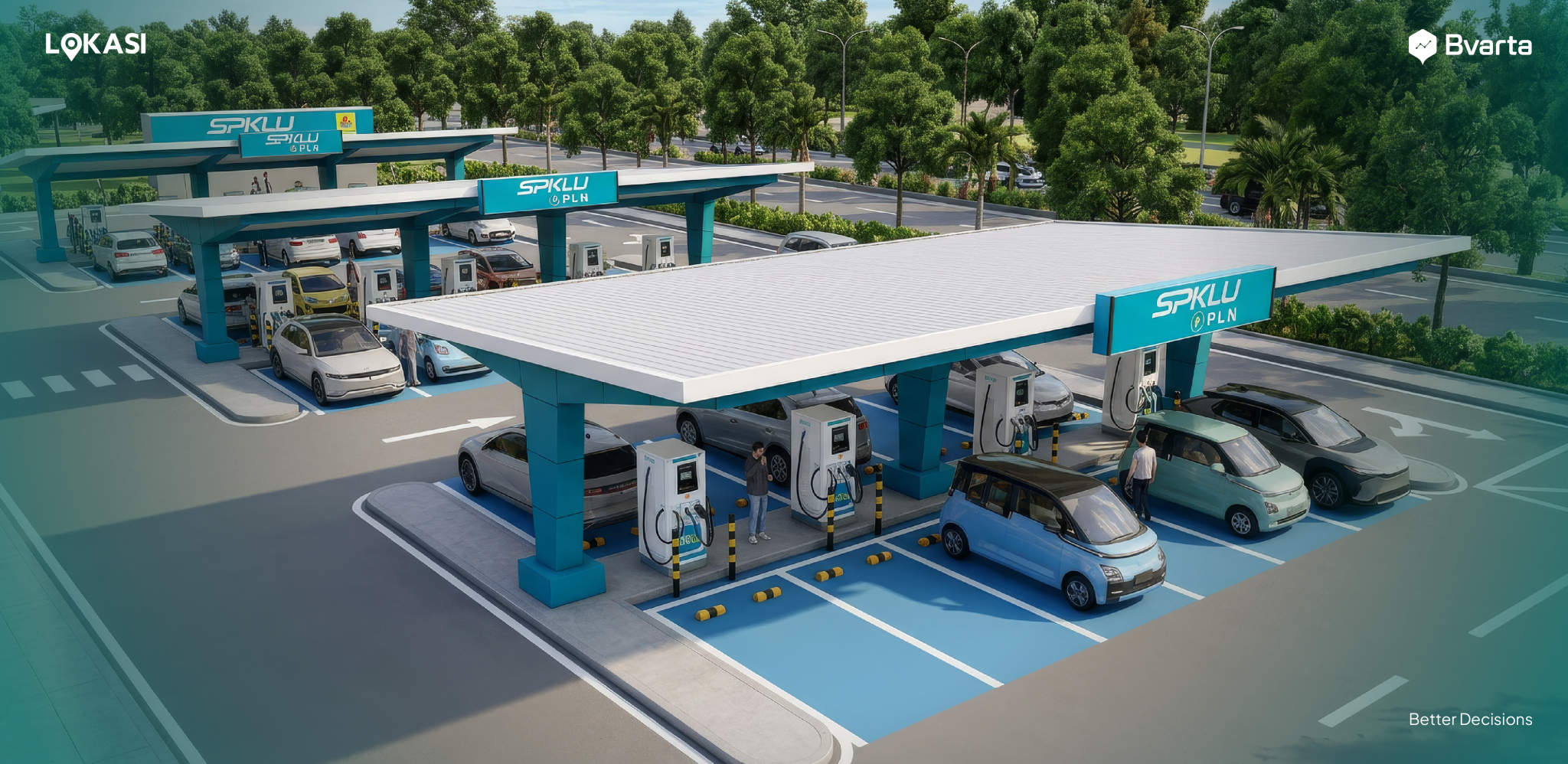
The numbers tell a clear story of demand outrunning supply.- According to the Ministry of Energy and Mineral Resources (ESDM), Indonesia had 4,892 four-wheel SPKLU units as of May 2026, spread across roughly 3,163 locations [1][2][3].
- By September 2026, the national count had passed 5,000, while the passenger EV population reached about 223,100 units, a ratio of roughly one charger for every 44 electric cars [4].
- The government’s SPKLU development plan targets 62,918 units by 2030 and 192,251 units by 2034, based on an assumption of 2.8 million electric cars on the road [5][6][7].
Step 1: Choose Your Business Model
Before you look at chargers or sites, decide how you want to participate. Your model shapes your capital needs, risk, and the kind of location you should look for.- Owner-operator. You invest in the equipment, run the station, and keep the charging revenue. This offers the highest upside and the highest exposure to location risk.
- Landlord or host model. You own a property (a mall, hotel, office, or parking lot) and partner with a charge point operator. You earn rent or a revenue share with lower capital outlay.
- Partnership with an established operator. You bring the site and local relationships while a larger operator brings equipment, software, and electricity supply arrangements.
- Fleet-focused model. You serve a specific customer group such as ride-hailing, logistics, or corporate fleets, where demand is more predictable.
Step 2: Understand the Regulatory and Licensing Basics
The licensing environment has become noticeably friendlier, but you still need to get the fundamentals right.- Business entity and NIB. Register your company and obtain a NIB through the OSS system.
- Land rights. Under earlier ESDM rules, the requirement for a recommendation from the local government was replaced by proof of land ownership or a cooperation agreement with the landowner [10]. Keep your lease or partnership documents clean and long-term.
- Environmental approval. SPKLU activities were reclassified to a medium-low risk level, and the standard UKL-UPL form is integrated between the AMDALnet and OSS systems [9].
- Reporting. SPKLU operators are expected to provide a reporting system integrated with the Directorate General of Electricity [10].
- Equipment standards. Chargers must meet applicable technical standards, and dispensing equipment is subject to calibration requirements similar to fuel dispensers.
Step 3: Pick the Right Charger Type for Your Use Case
Charger choice should follow the dwell time of your visitors, not the other way around.| Charger type | Typical dwell time | Best-fit locations |
|---|---|---|
| AC (slow/standard) | 2 to 8 hours | Offices, apartments, hotels, residential clusters |
| DC fast charging | 20 to 60 minutes | Malls, highway rest areas, major roads, fleet hubs |
| Ultra-fast DC | Under 30 minutes | Intercity corridors, high-traffic transit points |
Step 4: Build a Realistic Financial Model
A credible SPKLU business case rests on a few variables:- Capital expenditure: chargers, installation, civil works, grid connection, and signage.
- Operating expenditure: electricity cost, site rent or revenue share, maintenance, payment and software fees, and staffing or security.
- Revenue: price per kWh, plus ancillary income from advertising, retail, or parking.
- Utilization rate: the single most important driver. It is the percentage of time your chargers are actually in use.
Step 5: Select Your Location with Data, Not Intuition
This is where charging businesses are won or lost. A strong SPKLU location typically scores well on five factors.1. EV Demand Density
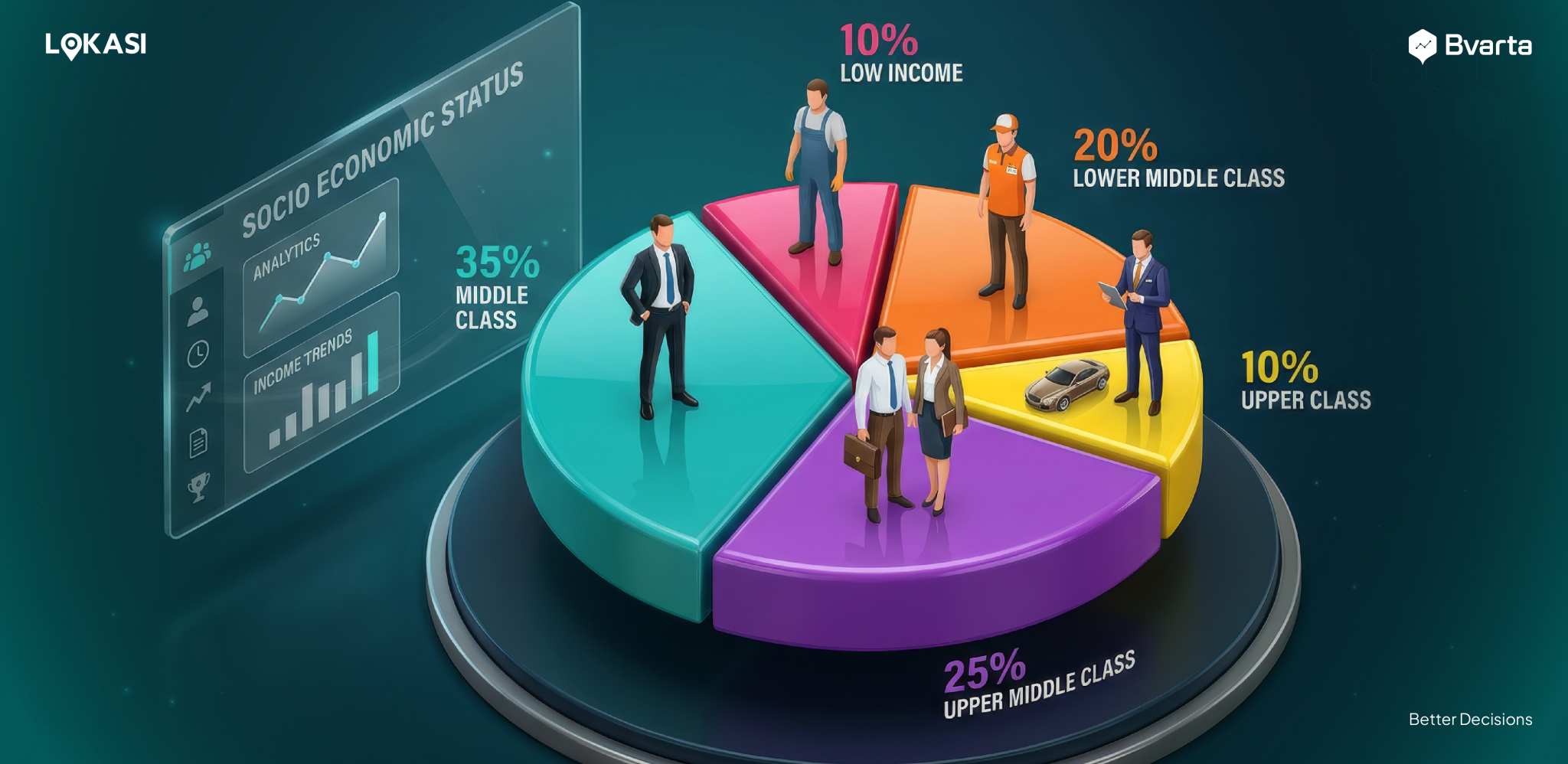
How many electric vehicles live, work, or pass through the area? Look at EV registrations, premium residential clusters, office districts, and ride-hailing activity. Demand is not evenly spread, even within a single city.2. Traffic Flow and Mobility Patterns
A busy road is not automatically a good charging site. What matters is who passes by, at what times, and whether they stop. Footfall at malls and destinations, commuting corridors, and weekend travel routes each create different demand profiles.3. Dwell Time and Destination Quality
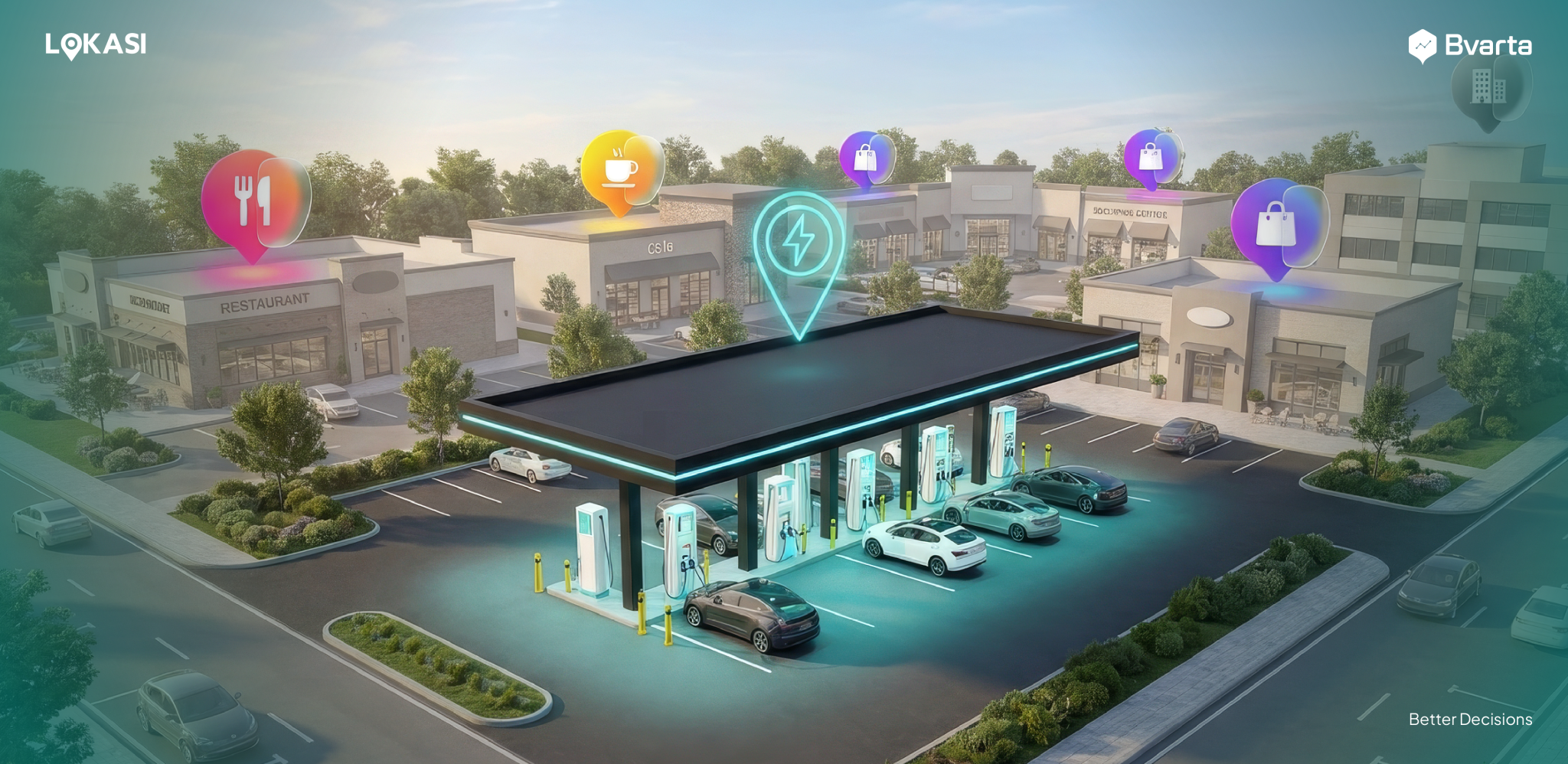
People are willing to charge where they already want to spend 30 to 90 minutes: shopping centers, restaurants, gyms, hotels, and business districts. A location with natural dwell time converts visitors into customers without asking them to change their routine.4. Competitive Landscape and Coverage Gaps
Map existing SPKLU and their capacity. A cluster of five chargers within one kilometer is a warning sign. A busy corridor with no chargers for 40 kilometers is an opportunity. Remember the national picture: supply is heavily concentrated in Java and Bali, so “white space” often exists in secondary cities and along intercity routes.5. Site Feasibility
Even a perfect market is useless if the site cannot support the build. Check grid capacity and the distance to a suitable power source, parking layout and vehicle flow, visibility and signage, safety, and lease terms. The challenge is that these signals sit in different datasets, in different formats, and are rarely visible from a desk. This is why leading operators increasingly rely on location intelligence.How Location Intelligence Changes the SPKLU Decision
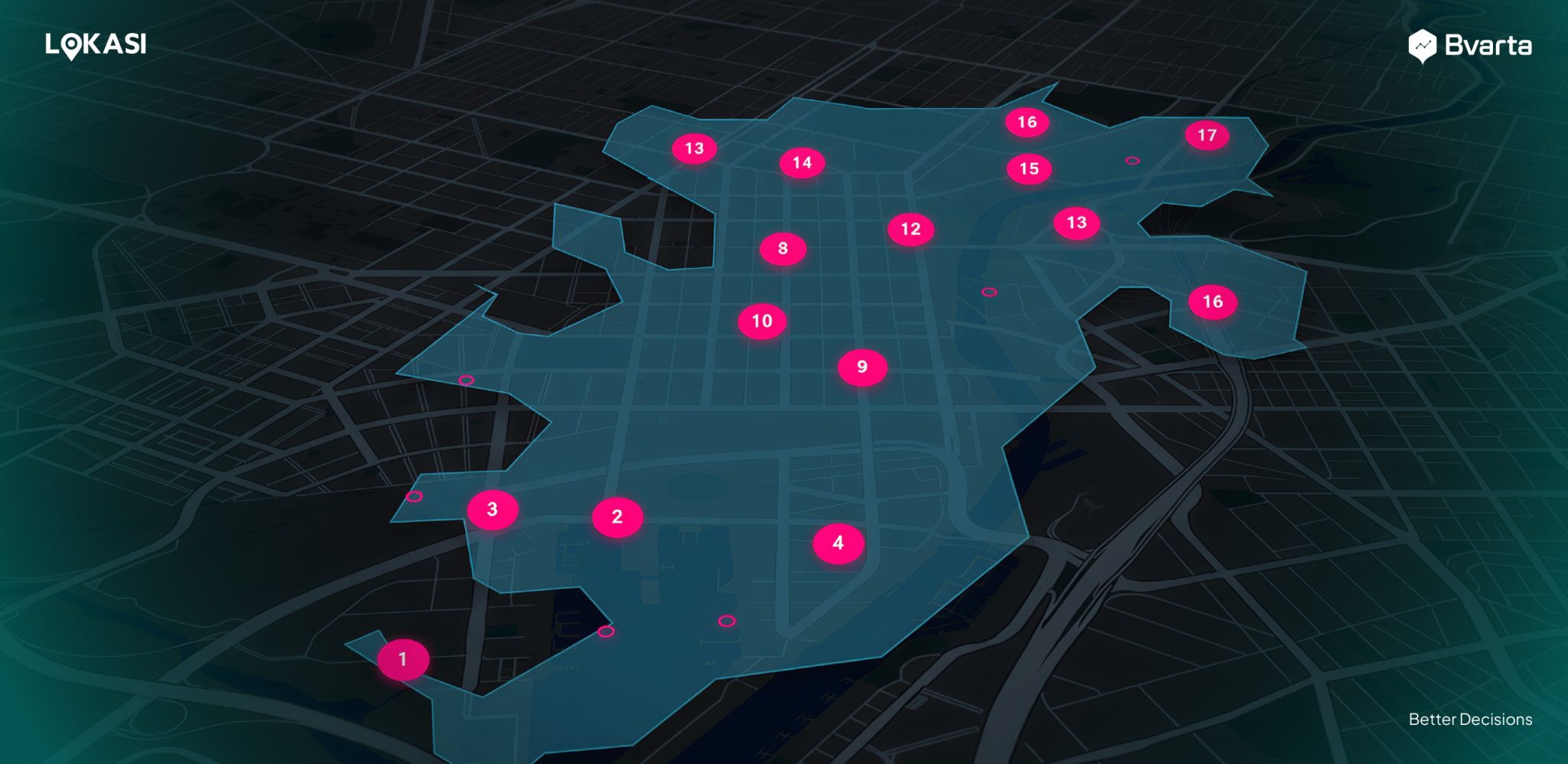
Location intelligence combines geospatial data, population and mobility signals, points of interest, and competitor mapping into a single view, so you can compare candidate sites objectively. With a platform such as LOKASI Intelligence by Bvarta, an SPKLU planner can:- See demand before building. Visualize population, activity, and movement patterns around a candidate site, using aggregated mobility insights rather than guesswork.
- Map the competition. Identify where charging points already exist and where coverage gaps are widest within a city or along a corridor.
- Profile the surrounding area. Understand the mix of malls, offices, residences, and transit hubs within a catchment area to estimate dwell time and visit potential.
- Shortlist and rank sites. Compare multiple locations side by side, so investment decisions rest on evidence that can be presented to partners, landowners, and investors.
- Scale with confidence. If you plan a network rather than a single station, apply the same analysis across dozens of locations to decide where to roll out first.
Step 6: Install, Commission, and Connect
Once your site is selected and approved:- Coordinate the power connection with the electricity provider, and confirm capacity early, because this is often the longest lead-time item.
- Complete civil and electrical works, including bays, protection, lighting, and signage.
- Install and commission chargers, and test them before opening to the public.
- Connect to payment and monitoring software, ideally compatible with the major EV charging apps and e-wallets so that drivers can find and pay easily.
- Register your station so it appears in navigation and charging-map apps.
Step 7: Operate, Measure, and Optimize
Opening day is the start, not the finish. Track these metrics from the first week:- Utilization rate by hour and day
- Average session duration and energy per session
- Revenue per charger
- Uptime and failure rate
- Customer ratings and repeat usage
Common Mistakes to Avoid
- Choosing a site because it is cheap or convenient. Low rent is no bargain if no one stops.
- Overbuilding on day one. Start with the capacity your demand data supports, and design the site so it can expand.
- Ignoring grid constraints until late in the project.
- Copying a competitor’s location without checking whether the area is already saturated.
- Neglecting uptime. One broken charger damages trust faster than a premium location can build it.
Frequently Asked Questions
- Is the SPKLU business profitable in Indonesia? Profitability depends on utilization, electricity cost, and capital cost. With EV adoption growing and charger coverage still thin, the long-term outlook is positive, but returns vary widely by site. That is why location analysis comes before equipment purchase.
- How much capital do I need to start? It depends on charger type, number of units, and site conditions. A host or partnership model can reduce upfront spending significantly compared with owning and operating the station yourself.
- Do I need a special license? Yes. At minimum you need a registered business entity and a NIB, along with environmental and technical compliance. Rules have been simplified recently, so check the latest regulation before you apply.
- What is the best location for an SPKLU? The best locations combine strong EV demand, natural dwell time, limited nearby competition, and a technically feasible site. Malls, business districts, premium residential areas, and intercity corridors with coverage gaps are common winners, but the right answer depends on your city and data.
- Can location intelligence really improve results? It cannot guarantee demand, but it replaces assumptions with measurable signals, which lowers the risk of choosing a poor site and helps you prioritize where to build first.